Saturday, 22 October 2016

Google form responses

We used google forms surveys to be able to see what our target audience our opening should be based on. From the results we have gathered from 14 different people, we decided to target males ages 15-18 as these had the highest percentages on the pie chart. Females are targeted as they also took part in completing our survey as well as people over the age of 18 years old.


Our third question on the survey was asking which genre to you prefer. The results came back and showed us that our idea of a psychological horror was successful as 78.6% said that they prefer psychological horrors. We also saw that 21.4% said that they prefer slasher films. Paranormal and action horror did not receive any votes. 
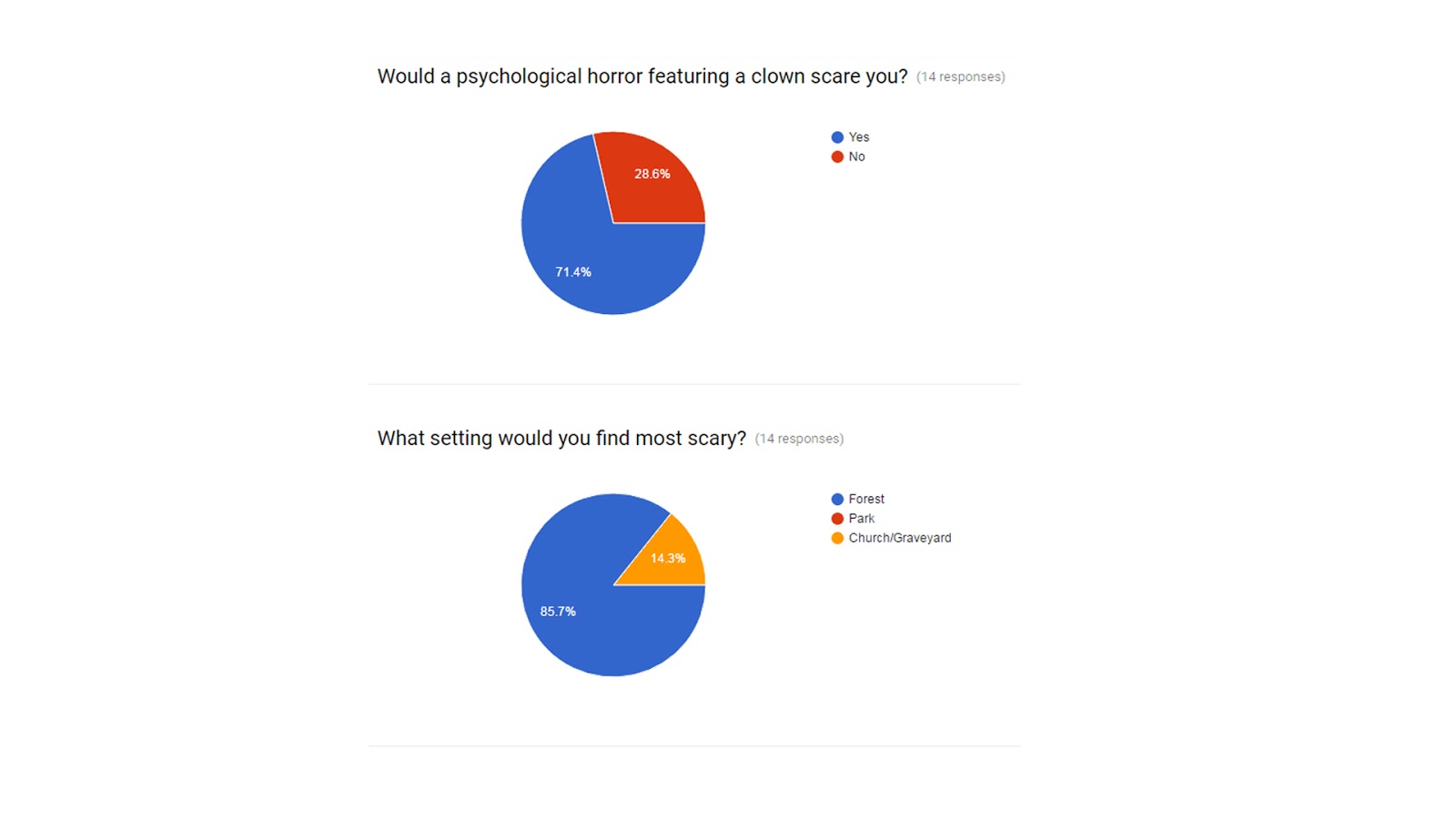
Our next question was to see if our idea of a scary psychological clown horror would scare our audience. Thankfully. the majority of our responses voted yes which was 71.4% of the results.
Unfortunately, the options we had asked for which setting would they find the most scary are all out of question due to the sudden outbreak of clowns. We have now decided that the idea place we should film would be in a house.

Target audience questionnaire

To find out more about our target audience, we created a questionnaire on google forms. This will fill us in on further information that we should then take into consideration which could then determine where and what we film.


Passive Audience Theories

Effects Theory:
The effects theory is a theory that suggests that for the audience to be passive, they must believe the text said in the films. It can have a negative effect on the audience as they are unable to control themselves from believing the text.

Hypodermic Needle:
This theory suggests that the audience are metaphorically injected with the information they receive from the text and instantly believe it. The media's message is like a drug to them.

My group have decided that we do not intend on using these theories in our opening due to the fact that we want our audience to look and discover hidden meanings in out dialogue, therefore we want them to be an active audience.

The Bobo doll experiment 
This experiment involved young children watching a video of an adult being violent towards a clown toy called the Bobo Doll. After watching the video, they were taken to a room with toys that they were not permitted to touch. Then they were moved to another room but this one had bobo dolls in it. The results gathered from this were that 88% of the children acted violently towards the doll and 8 months later, 40% of the children repeated the same violent behaviour. This experiment strongly supports the passive audience theories.

Active audience theories

Stuart Hall Reception Theory - Encoding and Decoding
Stuart Hall believes that many media texts and made and encoded with a hidden message. This text is encoded(added) by the producer based on the society they are living in at the present time. Then the audiences would then decode(understand) the hidden message. An issue from decoding the message is that not all individuals correctly understand the message being conveyed.

Stuart identified three different ways the message can be decoded. These are:

1. Dominant reading - where the audience decode the message the producer wanted them to and       agrees with it.
2. Negotiated reading - Where the audience partly agrees and disagrees with the message conveyed
3. Oppositional reading - Where the correct message is decoded but the audience disagrees due to political, cultural and ideological reasons


Uses and Gratifications Theory:
This theory was created by Blumer and Katz and they believe that the audience uses the text instead of the text using the audience. Therefore, the power lies with the audience and not with the producers and what message they want use to gain from the text. The audience simply use the text for their own gratification and pleasure. The audience may use the text to gratify needs for:
- Information
- Escapism
- Making comparisons
- Sexual stimulation

My group plan on using these audience theories in our own horror film as we can encode a message as to why the clown my be attacking which the audience can then decode for themselves. This would lead the audience to being passive as they are engaged with the film to work out the reasonings and explanations of events throughout.

Clown outbreak research


Events across America and the UK have occurred involving people dressing up as clowns and scaring innocent residents. Police across over 20 states have been recorded clown incidents from members of the public.

 As this is a popular topic on the news, we had to change our horror opening idea which has been difficult due to the short time space but fortunately, it has improved our narrative.

It is said that this outbreak was influenced by the film 'It' which in being remade and is planned on being released in 2017 in which Bill Skarsgard will play Pennywise, the clown. Images have been released promoting the new re-make but people are starting to believe the the fictional killer clown has influenced people around the world.

An incident that has occurred recently in Manchester was a mother in the car with her two children aged four and three years old, when a clown showed threatening behaviour as it climbed onto her car bonnet at the traffic lights. There are many more incidents that have been worse in which a resident was approached by a clown holding a hammer.


The picture on the right is an image taken by a man who's car was approached by two clowns who emerged from the bushes.

The police have warned residents that the clown craze will increase as we come closer to halloween.

We as a group have all agreed that we should film in a house and not in public as dressing up and threatening residents is illegal. Even though scaring locals is not our intentions, we can't help people seeing our clown and seeing it as a threat. Therefore, filming in a house is safer to the actor playing the clown.
The sudden outbreak of clowns has also improved our narrative as we are able to use real clips of clowns causing threat in public which we have turned into our own news report.


Friday, 21 October 2016

Main brief storyboard


Main brief planning

In our groups, we had all decided to create a psychological horror which involves a clown who is the murderer. This will begin with a series of short clips showing scary clowns chasing innocent people. We will present these short clips as a news report which would give the audience a sense of realism. 
We have decided to change our original pitch idea due to the sudden outbreak of clowns around America and the UK. Therefore it will be very difficult to film our opening in a forest or anywhere else in public as it may cause harm to our actors. Instead, we will be filming in a house to prevent any issues that may occur.

On our basic planning sheet, we have decided to hold auditions for the role of the clown as an additional part of the overall film. For this role, we have two potential candidates, Luke Scrivener and Joseph Deighton. For this opening, we also had to decide on what the target audience should be. Therefore, as a group, we decided that our film would be for ages around 15 -18 year olds . This is because we feel as though teenagers of this age range are most interested and enjoy the thrill of horrors. Furthermore, as fifteen year olds can watch it, we are able to include sexual references and activity, violence and strong language which all should not be in a great amount of detail.