Showing posts with label Target Audience. Show all posts

Wednesday, 16 November 2016

Smile feedback


After showing our opening to our peers who are aged 16-17, we then received feedback on what they liked and disliked about our film. They then used their likes and dislikes to give us a level from 1 to 4 on what they thought of our film. 
From looking at the feedback, we received an average of a level 3. The key idea to make our film better was to alter the sound in order to make it more suspenseful. Therefore, me and my group will carry out more sound research and change our sound in order to build up to a level 4. Also, from our feedback, we realised that teenage interests in horror are mainly suspense and being on the edge of their seats throughout.

Monday, 7 November 2016

Positive and negative feedback on rough cut


Once we had edited and added the sound to make it scary, we then asked a few of our peers to watch our opening and see what they think is good and what we need to improve on and perhaps change. We were then able for film two people who gave us feedback. From this, we were able to gain an insight on 16-17 year old boys views on horror films and what they enjoy watching. For example, they like how we have used suspense and darkness but would like us to include some foreshadowing in order to keep the audience interested to find out what may occur later on in the film.

Saturday, 22 October 2016

Google form responses

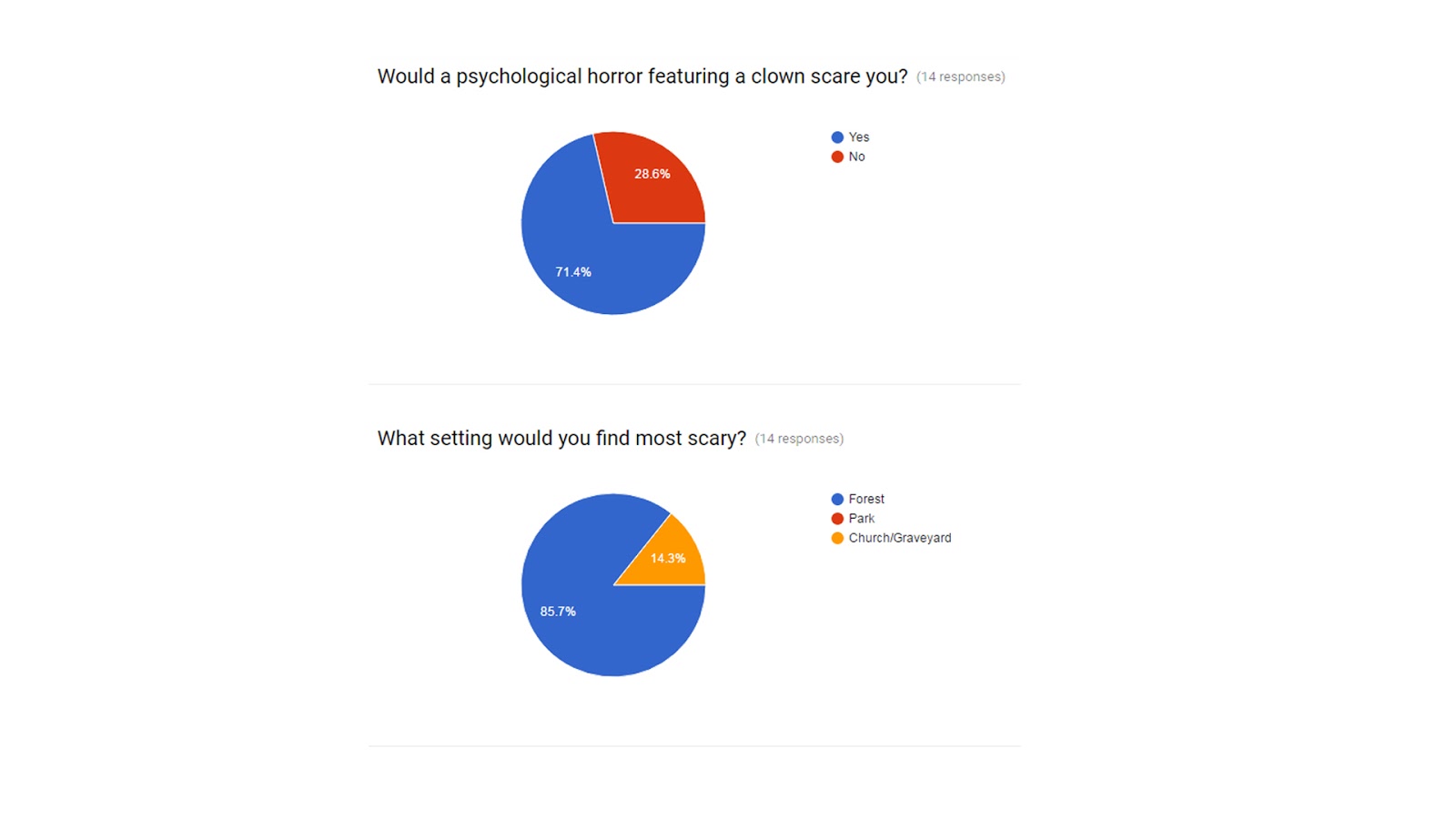
We used google forms surveys to be able to see what our target audience our opening should be based on. From the results we have gathered from 14 different people, we decided to target males ages 15-18 as these had the highest percentages on the pie chart. Females are targeted as they also took part in completing our survey as well as people over the age of 18 years old.


Our third question on the survey was asking which genre to you prefer. The results came back and showed us that our idea of a psychological horror was successful as 78.6% said that they prefer psychological horrors. We also saw that 21.4% said that they prefer slasher films. Paranormal and action horror did not receive any votes. 
Our next question was to see if our idea of a scary psychological clown horror would scare our audience. Thankfully. the majority of our responses voted yes which was 71.4% of the results.
Unfortunately, the options we had asked for which setting would they find the most scary are all out of question due to the sudden outbreak of clowns. We have now decided that the idea place we should film would be in a house.


Target audience questionnaire

To find out more about our target audience, we created a questionnaire on google forms. This will fill us in on further information that we should then take into consideration which could then determine where and what we film.


Passive Audience Theories

Effects Theory:
The effects theory is a theory that suggests that for the audience to be passive, they must believe the text said in the films. It can have a negative effect on the audience as they are unable to control themselves from believing the text.

Hypodermic Needle:
This theory suggests that the audience are metaphorically injected with the information they receive from the text and instantly believe it. The media's message is like a drug to them.

My group have decided that we do not intend on using these theories in our opening due to the fact that we want our audience to look and discover hidden meanings in out dialogue, therefore we want them to be an active audience.

The Bobo doll experiment 
This experiment involved young children watching a video of an adult being violent towards a clown toy called the Bobo Doll. After watching the video, they were taken to a room with toys that they were not permitted to touch. Then they were moved to another room but this one had bobo dolls in it. The results gathered from this were that 88% of the children acted violently towards the doll and 8 months later, 40% of the children repeated the same violent behaviour. This experiment strongly supports the passive audience theories.

Active audience theories

Stuart Hall Reception Theory - Encoding and Decoding
Stuart Hall believes that many media texts and made and encoded with a hidden message. This text is encoded(added) by the producer based on the society they are living in at the present time. Then the audiences would then decode(understand) the hidden message. An issue from decoding the message is that not all individuals correctly understand the message being conveyed.

Stuart identified three different ways the message can be decoded. These are:

1. Dominant reading - where the audience decode the message the producer wanted them to and       agrees with it.
2. Negotiated reading - Where the audience partly agrees and disagrees with the message conveyed
3. Oppositional reading - Where the correct message is decoded but the audience disagrees due to political, cultural and ideological reasons


Uses and Gratifications Theory:
This theory was created by Blumer and Katz and they believe that the audience uses the text instead of the text using the audience. Therefore, the power lies with the audience and not with the producers and what message they want use to gain from the text. The audience simply use the text for their own gratification and pleasure. The audience may use the text to gratify needs for:
- Information
- Escapism
- Making comparisons
- Sexual stimulation

My group plan on using these audience theories in our own horror film as we can encode a message as to why the clown my be attacking which the audience can then decode for themselves. This would lead the audience to being passive as they are engaged with the film to work out the reasonings and explanations of events throughout.

Saturday, 15 October 2016

Focus group: Favourite horror film

To find out more about our target audience, we put together two groups, a female group and a male group both ages 16-17. In our groups, we discussed what films were our favourite and least favourite with a explantation as to why they think this. This can be beneficial to my own opening as this additional information would help us greatly when creating the narrative which audiences our age would thoroughly enjoy as this age group watch horrors the most.


Thursday, 13 October 2016

YouGov - The Horror Channel

From using YouGov, I have carried out some secondary research which presents the type of audiences that enjoy 'The Horror Channel'. This British television channel presents horror films and series of all genres ranging from slasher to paranormal.
This research led me to gain an insight on the target audiences for horror films. The average age range for people who enjoy this channel are ages around 18-25 year olds. I am also able to see that mostly males watch horrors on this channel. This may be due to male interests being used in horrors such as violence. Whereas women come across and being less intrigued with the male interests. Lastly, I was able to see the films that these audiences enjoy to watch. From this, I am able to identify that these films are either horror or action-adventure films which also have a high chance of containing violent and graphic scenes.
For example, the horror 'Dawn of the Dead' is about a zombie apocalypse which included many violent and gory scenes. In another film genre, the action-adventure film, 'The Hobbit: An Unexpected Journey' also contains violence as fight scenes and deaths are included.
Therefore, from observing this table, horror audiences seem to be largely interested by the horror conventions, such as gore and jumpscares, more than any other genre. Furthermore, this will help me with my own horror opening as I can include many horror conventions to ensure that I target the correct audience.

Wednesday, 12 October 2016

YouGov profiles

Purge Anarchy
Scream


People who enjoy going to the cinema


These target audience YouGov profiles for both, 'The Purge' and 'Scream' help me realise that male and female genders can like one horror film more than the opposite sex. It also informed me that the age bracket for people who enjoy these films are 25-39 years olds. However, the age group of people who enjoy going to the cinema is 18-25 year olds. Therefore, our target audience also targets 18 years olds as we feel as though from these profiles that they would watch and distribute our film most. Also by carrying out this research, we gained the idea of distributing our film to many different cinemas. Both film profiles I have researched also have hobbies based around the media, therefore, this is beneficial when we would be in need of young adults to distribute our film.

Tuesday, 4 October 2016

Ages of people who go to the cinema


This graph contains secondary data which shows information on the percentage of different age groups that go to the cinema during an 11 year period. From this line graph, it shows ages 15-24 have the highest perentage from 2003 to 2014, therefore go to the cinema the most. However, this percentage varies due this period. For exampe, in 2003 it was arund 30% but fell in 2004 to around 26.5%. It continued to vary with a peak of around 35% in 2011.


In contrast ages 7-14 had a lower percentage. For example, in 2003 12.4% of children went to the cinema, however, the percentage increased to 17.8% in 2004. The percentage had continued to vary but up to 2011, it was 14.6%.


These variations could depend on the type of films that were released that year. There is evidence for this due to the percentage of 7-14 year olds increasing at the same time the percentage for 15-24 years olds is decreasing from 2003-4.


Due to the largest audience being teenagers and young adults, this shows us that they have the biggest interests within media. We are able to agree with this data due to this age group being known as being at their most sociable with friends and going on dates, therefore they could go to the cinema.


This secondary information has helped me with my own opening as it has ensyred me to target my film for this age range. I could do this by making them feel as though they can relate to this film through different ways such as making using teenage characters in the film.


Wednesday, 28 September 2016

Psychographic and Demographic audience

What is an audience?
An audience is a group of people who watch/experience a product/text.
E.g. read an advert, watch a film etc.


There are two different aspects to an audience, demographic and psychographic.


Demographic - This is the physical difference between people. E.g. Gender, Age, Religion, Ethnicity, Beliefs etc.

Ideas: As a group we decided to aim our film for ages 15-18 as we wanted our film to attract teenagers and young adults. Fortunately, due to eighteen year olds being targeted, this can then attract people older also. By setting this age bracket, it means that our film can not include too much gore and sexual references. Therefore, we plan to focus more on suspense building and being scared of the unknown instead of visual, gory horror. Our film will be suitable for both male and female to increase the size of the market for our film.


Psychographic -  This method puts people into categories based on their personality, interests, value, personal lifestyle, beliefs etc.
E.g. Vegetarian, outgoing etc.

Ideas: We aim for our film to be for people who are interested in horror and who enjoy being scared of the unknown. Preferably, our film would be most terrifying for those who have a fear of clowns, stalkers, the dark and any psychological fears.